core pure 3 notes

notes for the various chapters

1 proof
2 natural logarithms and exponentials
3 functions
4 differentiation techniques
5 integration techniques
Showing posts with label chapter 4. Show all posts

Wednesday, 9 November 2011

tangent and normal

finding the equation of the tangent and normal at a point involves substituting the x-coordinate into the gradient function (to find 'm') then using the x and y coordinates of the given point to work out what 'c' is

for this function, the turning point is identified (which can be related to the graph) and then the equations of the tangent and normal are found at the point where x = 9:

stationary points


Saturday, 5 November 2011

differentiating with respect to different variables

use the chain rule to link derivatives (differentials) with respect to different variables


Thursday, 13 October 2011

the product and quotient rule from first principles


product rule examples

product rule examples


(differentiate first) times (the second) then +  (the first) times (differential of the second)


when factorising, extract the lowest power of a common function


in this question, use the product rule to find the differential and then relate the turning points to the graph


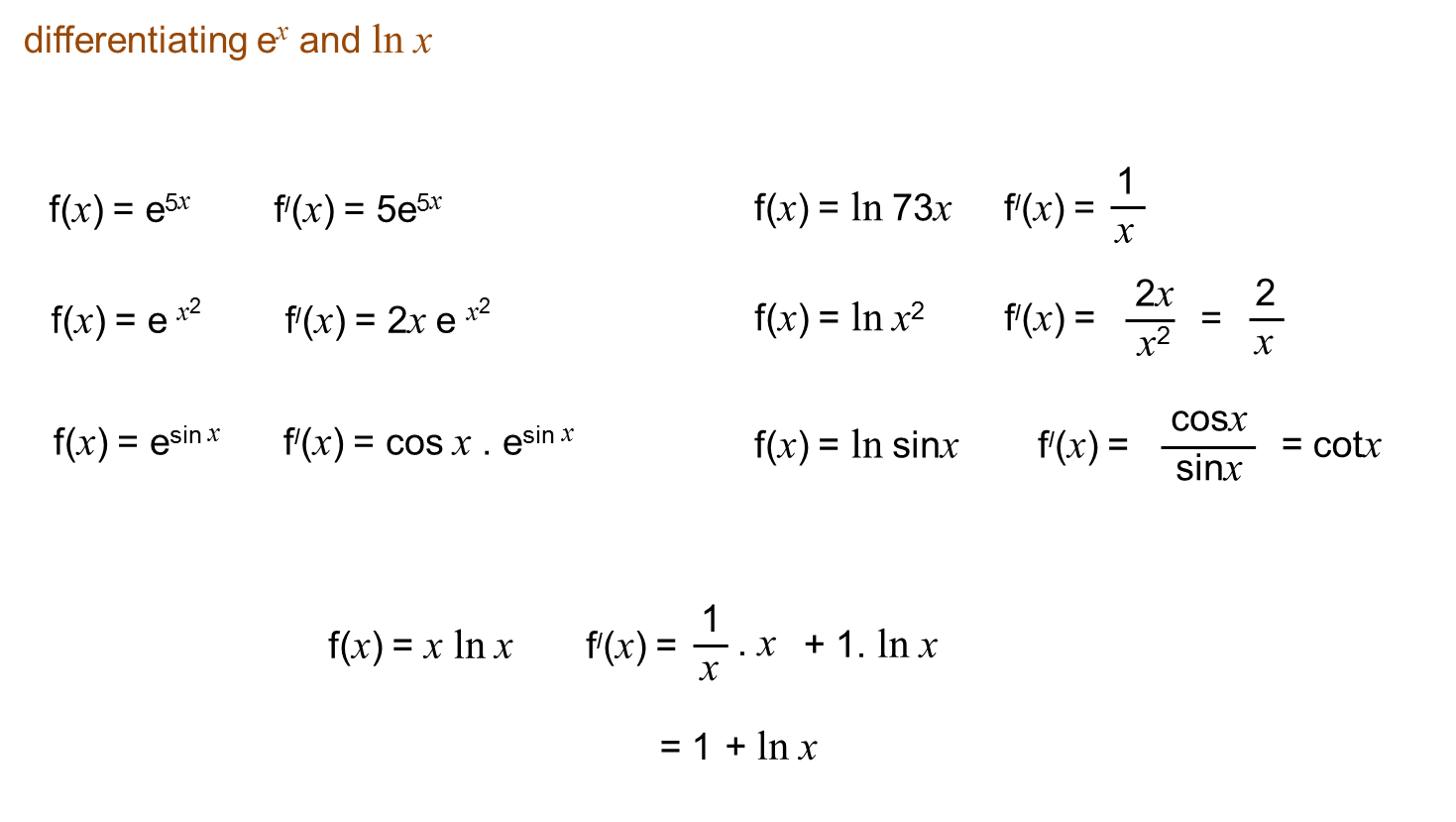
some other examples, involving exponential, logarithmic and trig functions

product and quotient rule

 
an example of the product rule on Vimeo
an example of the quotient rule on Vimeo

chain rule

see this explained on Vimeo

here they use the terms 'inside function' and 'outside function'

the derivative is
the derivate of the outside function x
derivative of inside function


to see how the chain rule works, from some simple examples:


a couple of simple examples: